Chinese Ferdinand Verbiest Cultural Exchange Association launched a church history course in the spring and early summer of 2025. The promotional materials at the time were as follows:
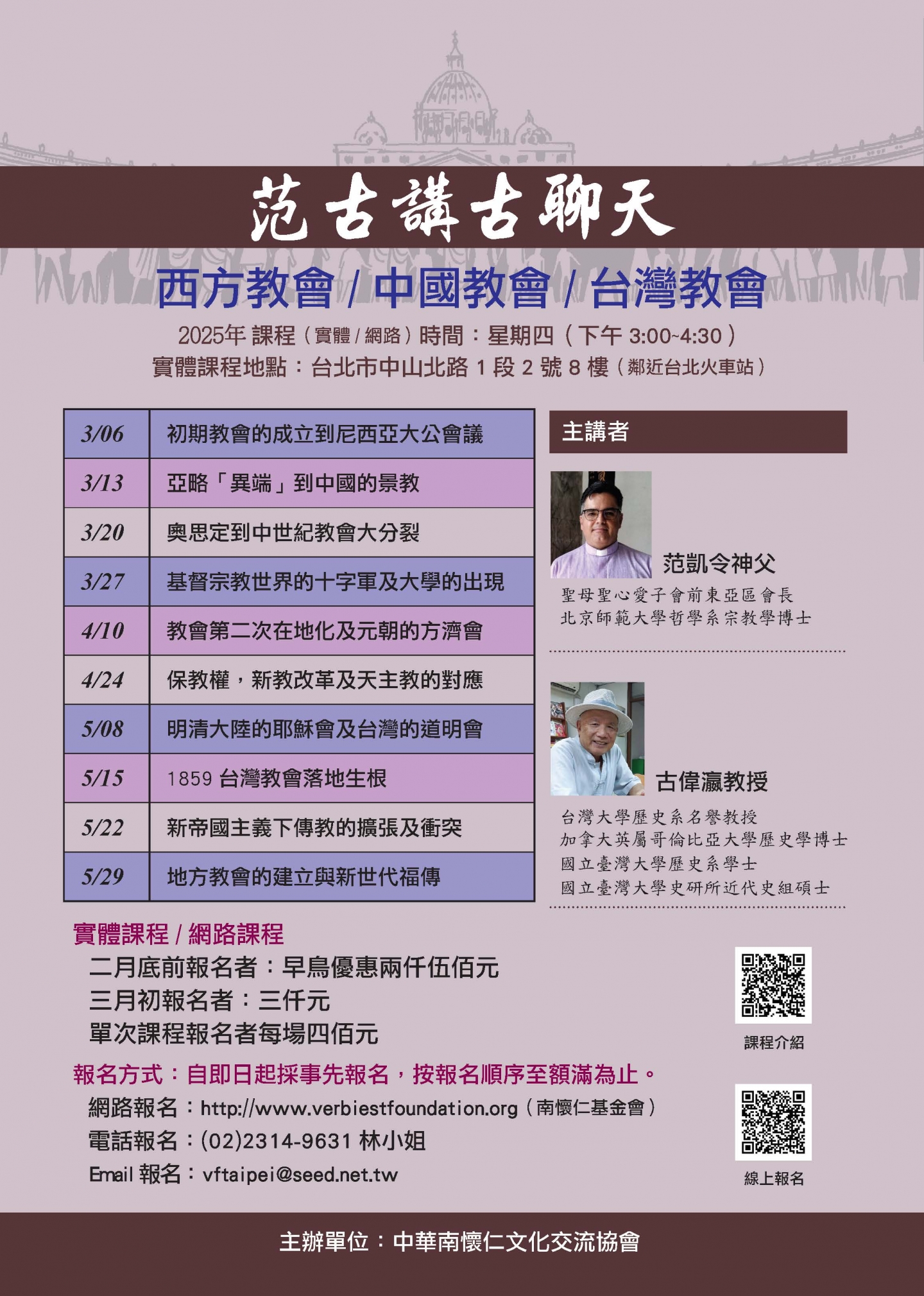
“Fan Gu's Storytelling and Conversations on Church history” – Brochure (1)
Registration and fee for In-person courses / Online courses
Those who register before the end of February: Early bird discount of NT$2,500.
Those who registered in early March: 3,000 yuan
For single-session course registrations, the price is 400 yuan per session.
Registration and fee for In-person courses / Online courses
Those who register before the end of February: Early bird discount of NT$2,500.
Those who registered in early March: 3,000 yuan
For single-session course registrations, the price is 400 yuan per session.
“Fan Gu's Storytelling and Conversations on Church history” – Brochure (2)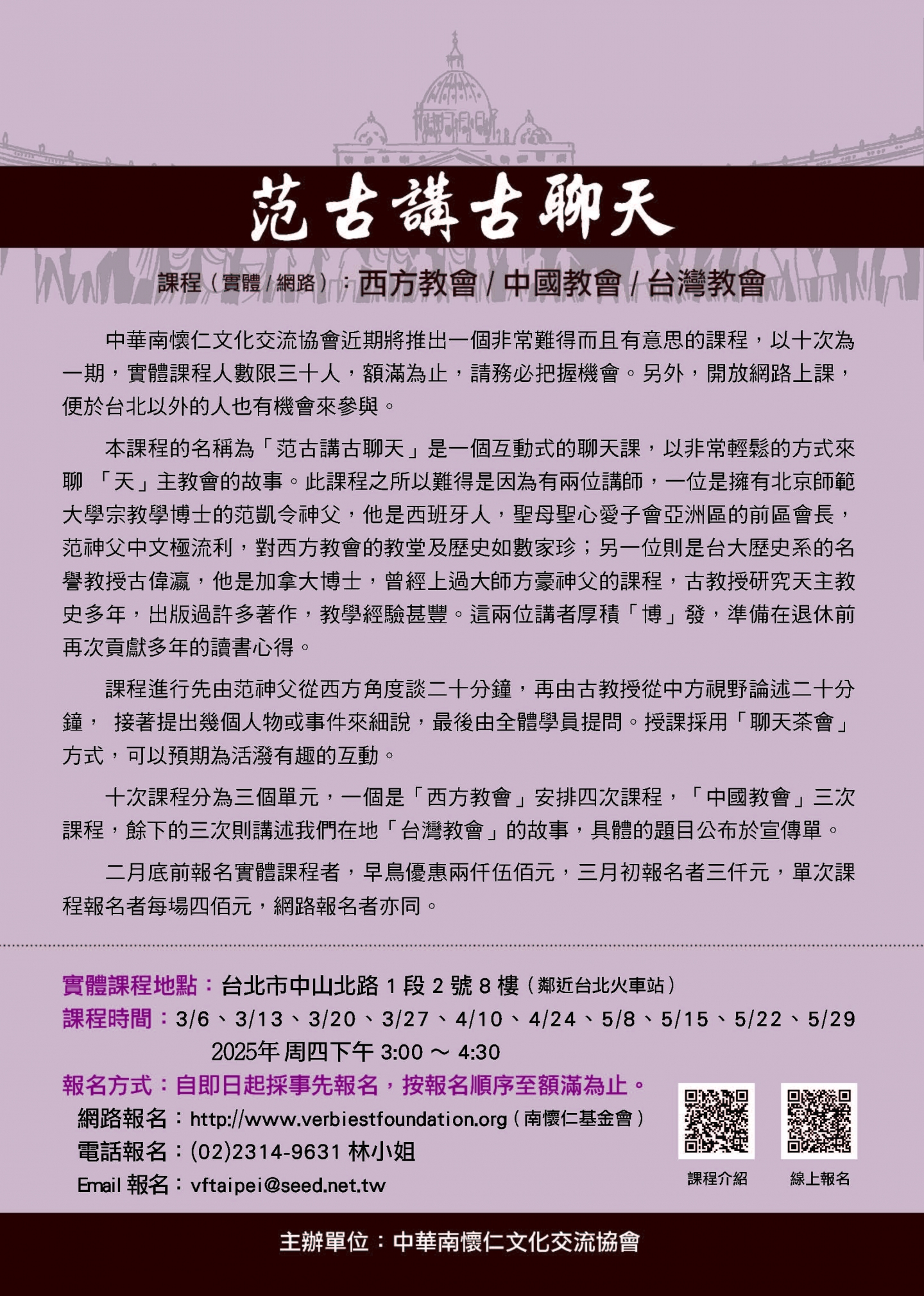 The Chinese Ferdinand Verbiest Cultural Exchange Association will soon be launching a quite unusual and interesting course, consisting of ten sessions per course. The in-person course is limited to thirty participants on a first-come, first-served basis, so please seize this opportunity. In addition, online classes will also be available to allow people outside of Taipei to participate.
This course, titled “Fan Gu's Storytelling and Conversations on Church history” is an interactive conversational-style class that discusses the stories of the Catholic Church in a very relaxed manner. What makes this course special is its two lecturers: Father Fan Kailing, a Spaniard with a PhD in Religious Studies from Beijing Normal University and the former regional superior of the Claretian Missionaries East Asia Delegation, who is fluent in Mandarin and possesses extensive knowledge of Western churches and history; the other lecturer is Professor Emeritus Gu Weiying of the Department of History at National Taiwan University, holding a Canadian PhD who has previously taken courses taught by the renowned Father Fang Hao. Professor Gu has researched Catholic history for many years, published numerous works, and has extensive teaching experience. Both lecturers, with their profound knowledge and extensive experience, are preparing to share their insights from years of reading before their retirement.
The course begins with Father Fan speaking from a Western perspective for twenty minutes, followed by Professor Gu's twenty-minute discussion from a Chinese perspective. Several figures or events are then presented in detail, and the course concludes with a Q&A session for all participants. The teaching style is kind of a "chatting tea party," promising a lively and engaging interactive experience.
The ten courses are divided into three units: four courses for events of the "Western Church", three courses for events of the "Chinese Church", and the remaining three courses will tell events of our local "Taiwanese Church". The specific topics are announced in the flyer.
Those who register for in-person courses before the end of February will receive an early bird discount of NT$2,500, those who register in early March will receive NT$3,000, and those who register for a single course will receive NT$400 per session. The same applies to those who register online.
Speakers Background:
Professor Gu Weiying's Introduction
1. Current position:
Professor Emeritus, Department of History, National Taiwan University
Director and Research Consultant of the Chinese Ferdinand Verbiest Cultural Exchange Association
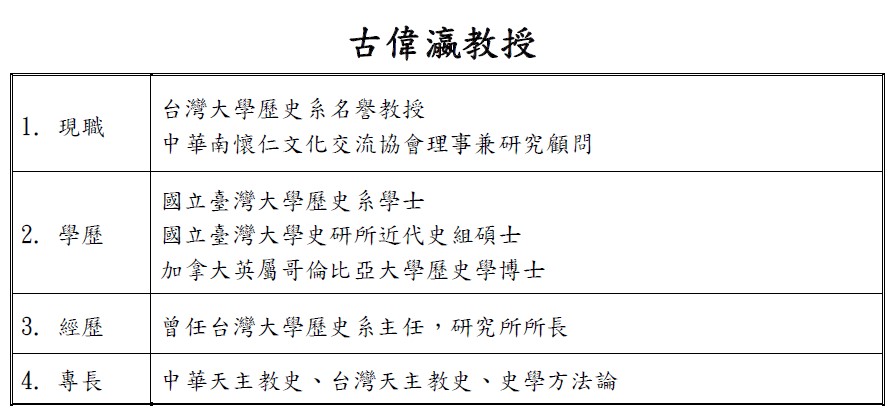 2. Educational qualifications
Bachelor of History, National Taiwan University
Master of Modern History, Institute of History, National Taiwan University
PhD in History from the University of British Columbia, Canada
3. Experience
He previously served as the head of the Department of History and the director of the Graduate Institute at National Taiwan University.
4. Expertise
History of Catholicism in China, History of Catholicism in Taiwan, Historiographical Methodology
Fr. Francisco Carin, CMF ‘s Introduction
1. Current position
Former Superior of the East Asia Delegation of the Claretian Missionaries
Director and Research Consultant of the Chinese Frdinand Verbiest Cultural Exchange Association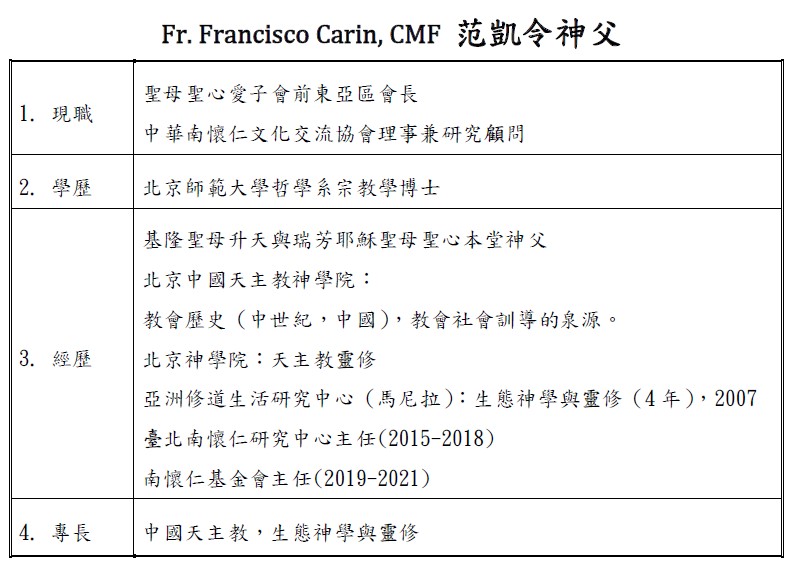 2. Educational qualifications
Doctor of Religious Studies, Department of Philosophy, Beijing Normal University
Licenciate in Theology (Spirituality (Ecological Spirituality) at FuJen’s St. Robert Bellarmine School of Theology)
3. Experience
Invited Professor at Beijing’s China Catholic Theological Seminary (Church history (medieval and China), the sources of church social teaching.
Institute of Consecrated Life Asia (Manila): Ecological Theology and Spirituality (4 years), 2007
Director of the Taipei Ferdinand Verbiest Research Center (2015-2018)
Director of the Ferdinand Verbiest Foundation (2019-2021)
Parish priest of Keelung, the Assumption of Our Lady and the Sacred Heart of Jesus in Ruifang
4. Expertise
Chinese Catholicism, Ecological Theology and Spirituality
This course breaks away from the traditional one-way lecture format, offering an interactive conversation-style class that discusses the history of the Catholic Church in a very relaxed way.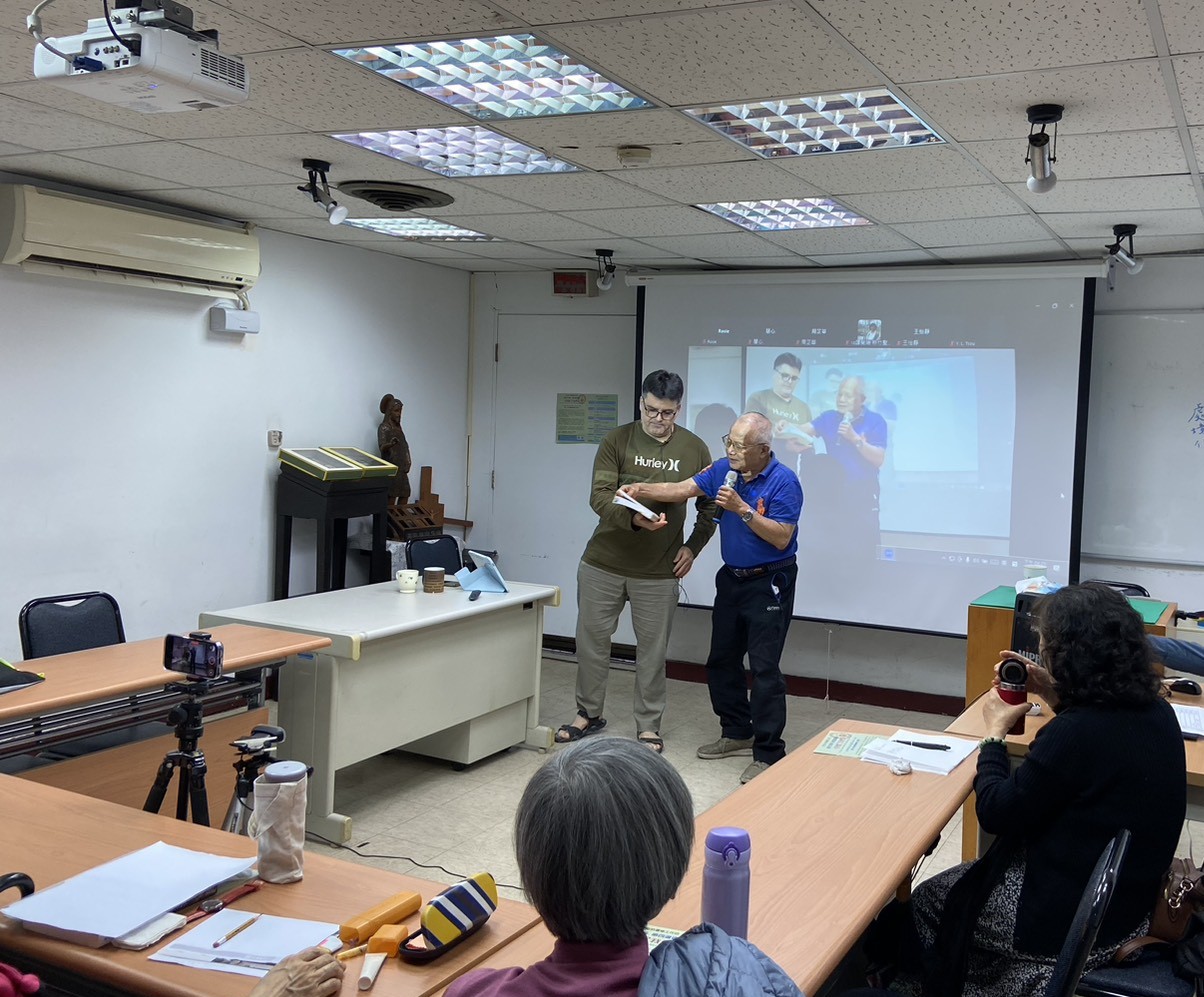 It is divided into ten sessions with three thematic units intertwined throughout the course: one on the Western Church (four sessions), one on the Chinese Church (three sessions), and the remaining three sessions on the story of the Taiwanese Church. The teaching method consists of PPT presentations, short videos, and storytelling. Professor Gu Weiying speaks for 25 minutes, followed by Father Fan Kailing for 25 minutes. The remaining time is for questions and answers. Each session follows a predetermined topic. Professor Gu presents from a Chinese perspective, while Father Fan offers a Western viewpoint. Both the videos and images were helped dialogue and understanding of the topics.
Professor Gu Weiying has taught many popular general education courses on "Historical Turning Points" at National Taiwan University, and the essence of those courses forms part of this course, making this course equivalent to attending a National Taiwan University course. Father Fan's presentation featured historically significant images and tables, from which I benefited greatly. Furthermore, the second and third lectures were taught by Professor Fan Jingsheng, also an expert in church history, supplemented by Professor Gu's PowerPoint presentations. This course has been recorded and post-production completed, and the videos will be uploaded at the end of November for those interested to purchase and subscribe [click this link for pre-subscription information]. Finally, I've included some photos from the class, along with reflections from three students, for your reference and feedback.
Reflection 1: This is a well-structured and comprehensive course on church history, providing a complete and in-depth overview of Catholic history. It offers both a macro-level historical framework and detailed case studies, with several key features: a vast time span and rich content; the use of keywords to capture core concepts and historical context; a deep focus on the development of the Church in China and Taiwan; and an introduction to many important figures and their significance in their respective eras. The content is broad and insightful.
Reflection 2: Throughout human history, God has led His creation step by step towards Him and into His Kingdom. Therefore, studying history truly allows us to see His unseen hand guiding all historical events and people with His purpose.
Because of Fan Gu's lectures, we were able to understand and explore all of this. Each lecture was insightful yet accessible, presenting history in an engaging way. How fortunate we are to enjoy the fruits of their years of dedicated research and to understand the historical context and the events that unfolded.
My heart is filled with praise and gratitude to God for His wondrous creation, leading us to His Kingdom. Amen.
Reflection 3: Initially, the title "Conversations" seemed lighthearted, but it turned out to be anything but lighthearted. The content encompassed the Western Church and the Church in Taiwan, almost a concise history of Church development, all closely related to our faith. I gained a great deal, especially from the different perspectives offered, which deepened my knowledge.
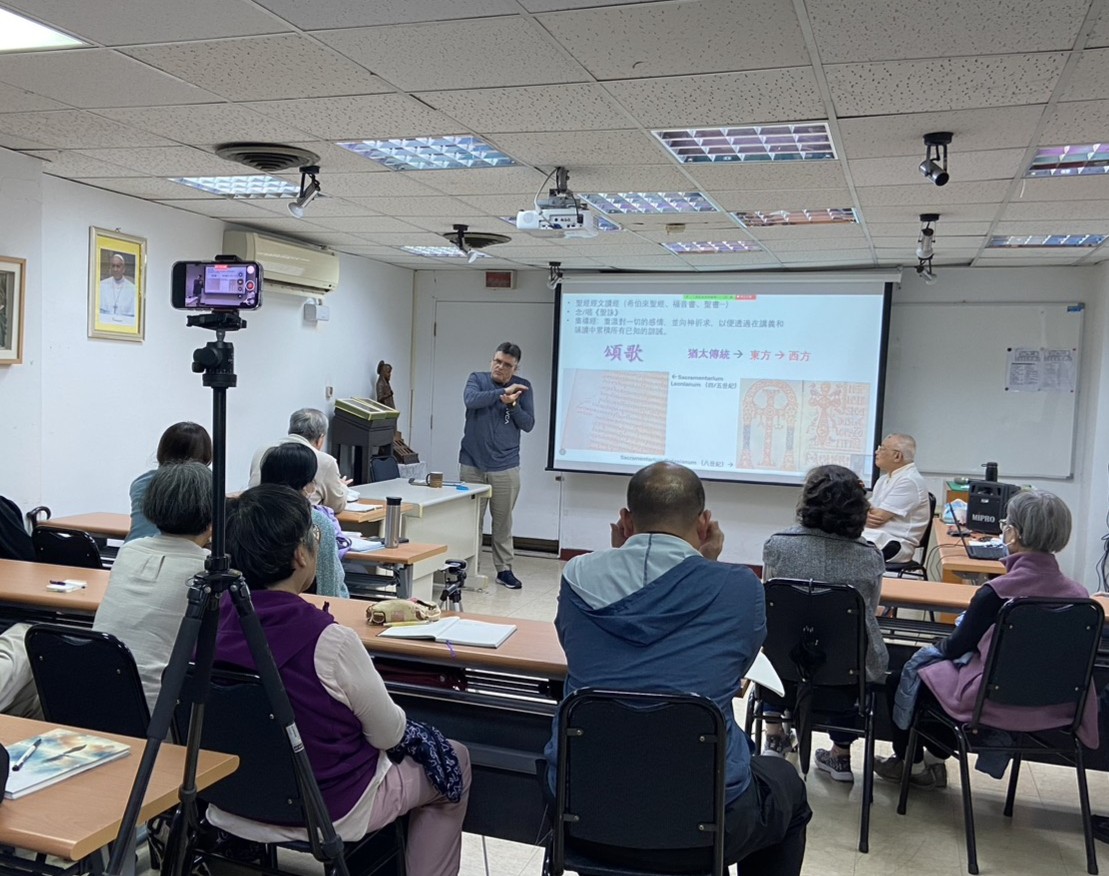 I particularly appreciated Professor Gu's explanations of key phrases, which allowed me to quickly grasp the main points and left a lasting impression on the subsequent historical narrative. Father Fan's explanations of the historical turning points were also insightful and crucial. I felt fortunate to have participated in such a fulfilling journey through the history of my faith.
The Western Religious History course broadened my horizons, especially for me in the reading group, giving me a new understanding of the Church. It led us from doctrine into the historical context, combining faith and reason.
The course on the missionary work of Catholicism in China and Taiwan was particularly noteworthy. The two lecturers used a humorous, lively, and solid dialogue-style approach, providing a unique and enriching learning experience. The professor supplemented the course with rich historical materials and cultural context, especially his exploration of missionary work in Chinese-speaking regions, which made me deeply appreciate the complexity and profoundness of the interaction between missionary work and local culture. Overall, it was a high-quality course that combined knowledge with reflection.
“Fan Gu's Storytelling and Conversations on Church history” – Brochure (1)
- 3/06: From the founding of the early church to the Council of Nicaea.
- 3/13: Arian "heresy" Nestorianism enters China.
- 3/20: From Augustine to the Great Schism of the Middle Ages.
- 3/27: Medieval Christendom: Between Universities and the Crusades.
- 4/10: The Second Indigenization of the Church in China: the Franciscan Order in the Yuan Dynasty.
- 4/24: The “Padroado”, the Protestant Reformation and the Catholic Church's response.
- 5/08: Jesuits in mainland China and Dominicans in Taiwan during the Ming and Qing dynasties.
- 5/15: 1859: The Catholic Church takes root in Taiwan.
- 5/22: Missionary Work under Neo-Imperialism: Expansion and Conflict.
- 5/29: The establishment of local churches and evangelization for a new age
Registration and fee for In-person courses / Online courses
Those who register before the end of February: Early bird discount of NT$2,500.
Those who registered in early March: 3,000 yuan
For single-session course registrations, the price is 400 yuan per session.
Registration and fee for In-person courses / Online courses
Those who register before the end of February: Early bird discount of NT$2,500.
Those who registered in early March: 3,000 yuan
For single-session course registrations, the price is 400 yuan per session.
“Fan Gu's Storytelling and Conversations on Church history” – Brochure (2)
This course, titled “Fan Gu's Storytelling and Conversations on Church history” is an interactive conversational-style class that discusses the stories of the Catholic Church in a very relaxed manner. What makes this course special is its two lecturers: Father Fan Kailing, a Spaniard with a PhD in Religious Studies from Beijing Normal University and the former regional superior of the Claretian Missionaries East Asia Delegation, who is fluent in Mandarin and possesses extensive knowledge of Western churches and history; the other lecturer is Professor Emeritus Gu Weiying of the Department of History at National Taiwan University, holding a Canadian PhD who has previously taken courses taught by the renowned Father Fang Hao. Professor Gu has researched Catholic history for many years, published numerous works, and has extensive teaching experience. Both lecturers, with their profound knowledge and extensive experience, are preparing to share their insights from years of reading before their retirement.
The course begins with Father Fan speaking from a Western perspective for twenty minutes, followed by Professor Gu's twenty-minute discussion from a Chinese perspective. Several figures or events are then presented in detail, and the course concludes with a Q&A session for all participants. The teaching style is kind of a "chatting tea party," promising a lively and engaging interactive experience.
The ten courses are divided into three units: four courses for events of the "Western Church", three courses for events of the "Chinese Church", and the remaining three courses will tell events of our local "Taiwanese Church". The specific topics are announced in the flyer.
Those who register for in-person courses before the end of February will receive an early bird discount of NT$2,500, those who register in early March will receive NT$3,000, and those who register for a single course will receive NT$400 per session. The same applies to those who register online.
Speakers Background:
Professor Gu Weiying's Introduction
1. Current position:
Professor Emeritus, Department of History, National Taiwan University
Director and Research Consultant of the Chinese Ferdinand Verbiest Cultural Exchange Association
2. Educational qualificationsBachelor of History, National Taiwan University
Master of Modern History, Institute of History, National Taiwan University
PhD in History from the University of British Columbia, Canada
3. Experience
He previously served as the head of the Department of History and the director of the Graduate Institute at National Taiwan University.
4. Expertise
History of Catholicism in China, History of Catholicism in Taiwan, Historiographical Methodology
Fr. Francisco Carin, CMF ‘s Introduction
1. Current position
Former Superior of the East Asia Delegation of the Claretian Missionaries
Director and Research Consultant of the Chinese Frdinand Verbiest Cultural Exchange Association
Doctor of Religious Studies, Department of Philosophy, Beijing Normal University
Licenciate in Theology (Spirituality (Ecological Spirituality) at FuJen’s St. Robert Bellarmine School of Theology)
3. Experience
Invited Professor at Beijing’s China Catholic Theological Seminary (Church history (medieval and China), the sources of church social teaching.
Institute of Consecrated Life Asia (Manila): Ecological Theology and Spirituality (4 years), 2007
Director of the Taipei Ferdinand Verbiest Research Center (2015-2018)
Director of the Ferdinand Verbiest Foundation (2019-2021)
Parish priest of Keelung, the Assumption of Our Lady and the Sacred Heart of Jesus in Ruifang
4. Expertise
Chinese Catholicism, Ecological Theology and Spirituality
This course breaks away from the traditional one-way lecture format, offering an interactive conversation-style class that discusses the history of the Catholic Church in a very relaxed way.
It is divided into ten sessions with three thematic units intertwined throughout the course: one on the Western Church (four sessions), one on the Chinese Church (three sessions), and the remaining three sessions on the story of the Taiwanese Church. The teaching method consists of PPT presentations, short videos, and storytelling. Professor Gu Weiying speaks for 25 minutes, followed by Father Fan Kailing for 25 minutes. The remaining time is for questions and answers. Each session follows a predetermined topic. Professor Gu presents from a Chinese perspective, while Father Fan offers a Western viewpoint. Both the videos and images were helped dialogue and understanding of the topics.Professor Gu Weiying has taught many popular general education courses on "Historical Turning Points" at National Taiwan University, and the essence of those courses forms part of this course, making this course equivalent to attending a National Taiwan University course. Father Fan's presentation featured historically significant images and tables, from which I benefited greatly. Furthermore, the second and third lectures were taught by Professor Fan Jingsheng, also an expert in church history, supplemented by Professor Gu's PowerPoint presentations. This course has been recorded and post-production completed, and the videos will be uploaded at the end of November for those interested to purchase and subscribe [click this link for pre-subscription information]. Finally, I've included some photos from the class, along with reflections from three students, for your reference and feedback.
Reflection 1: This is a well-structured and comprehensive course on church history, providing a complete and in-depth overview of Catholic history. It offers both a macro-level historical framework and detailed case studies, with several key features: a vast time span and rich content; the use of keywords to capture core concepts and historical context; a deep focus on the development of the Church in China and Taiwan; and an introduction to many important figures and their significance in their respective eras. The content is broad and insightful.
Reflection 2: Throughout human history, God has led His creation step by step towards Him and into His Kingdom. Therefore, studying history truly allows us to see His unseen hand guiding all historical events and people with His purpose.
Because of Fan Gu's lectures, we were able to understand and explore all of this. Each lecture was insightful yet accessible, presenting history in an engaging way. How fortunate we are to enjoy the fruits of their years of dedicated research and to understand the historical context and the events that unfolded.
My heart is filled with praise and gratitude to God for His wondrous creation, leading us to His Kingdom. Amen.
Reflection 3: Initially, the title "Conversations" seemed lighthearted, but it turned out to be anything but lighthearted. The content encompassed the Western Church and the Church in Taiwan, almost a concise history of Church development, all closely related to our faith. I gained a great deal, especially from the different perspectives offered, which deepened my knowledge.
I particularly appreciated Professor Gu's explanations of key phrases, which allowed me to quickly grasp the main points and left a lasting impression on the subsequent historical narrative. Father Fan's explanations of the historical turning points were also insightful and crucial. I felt fortunate to have participated in such a fulfilling journey through the history of my faith.The Western Religious History course broadened my horizons, especially for me in the reading group, giving me a new understanding of the Church. It led us from doctrine into the historical context, combining faith and reason.
The course on the missionary work of Catholicism in China and Taiwan was particularly noteworthy. The two lecturers used a humorous, lively, and solid dialogue-style approach, providing a unique and enriching learning experience. The professor supplemented the course with rich historical materials and cultural context, especially his exploration of missionary work in Chinese-speaking regions, which made me deeply appreciate the complexity and profoundness of the interaction between missionary work and local culture. Overall, it was a high-quality course that combined knowledge with reflection.